By Teresa Swartz Roberts
Blog Post 57. Copyright 2024
Maybe I am the recipient of a little bit of poetic justice. When I met my future daughter-in-law, I thought she was polite and sweet—until dinnertime. She came to our house to eat a birthday dinner, but she didn’t eat any of the pasta sauce my husband had prepared from scratch for this special occasion. I started writing her off as rude and self-centered.
Now, a decade later, I am the one refusing the homemade sauce, the yeasty bread, the birthday cake. They just don’t taste the same anymore. Like many Covid-19 survivors, I have had my senses of smell and taste changed or diminished. But it wasn’t covid that did it; it was Parkinson’s. One of the little-known non-motor symptoms is changes in how the body perceives odors and tastes.
I was a member of The Clean Plate Club from birth. I ate every single bite, winning praise for being a good eater. My mother provided meals for three growing boys and a little girl who was in competition to eat as much as they did, and while there was always enough food to keep us growing, I would eat until the food was gone, not until I was full. I was never full.
If you follow the logic of my generation, obedience when it comes to eating what’s in front of you is good, and not finishing your plate, whether you like the food or not, is bad. There was always some hypothetical child in another part of the world who was hungry and would be happy to eat what I had on my plate.
Being allergic wasn’t even an excuse when I was little. You’d have to swell up like a sponge or barf into your plate to be taken seriously.
I used to think that people who didn’t finish their plates were spoiled in some way. Their parents were somehow neglectful, not forcing food onto their children, not guilting them into eating.
When I became a mother, I had to beware of the ghosts I was bringing to the kitchen table when I tried to persuade The Boy to take just one more bite. I thought I was enlightened, that I had conquered food addiction by raising a normal-sized human in a body that had obesity genes from both parents.
Once, when we were visiting The Boy’s grandparents, Grandpa told him that he couldn’t have dessert unless he ate everything on his plate. I explained that Grandpa had different rules for his house than we had for ours. He thought for a beat and said, “That’s okay. I don’t need dessert.” That made me smug.
Enter my daughter-in-law. When I met The Boy’s then-girlfriend, I liked her. But on some level, I felt judgmental of her picky eating. She came over for a birthday dinner. My husband cooked for her. For My Honey, food equals love. But The Girlfriend wouldn’t –or couldn’t—accept the love. It seemed to me cold and selfish. I was wrong. Not being able to accept a heartfelt hug in the form of food is darned inconvenient, especially when you’re meeting your new boyfriend’s parents.
In fact, having a different reaction to the taste of foods than everybody else does is pretty much a disability. It’s not a choice. I wouldn’t choose to go to a party and not be able to eat anything there, not to enjoy any of the food. I wouldn’t choose to go to Olive Garden and eat nothing but noodles because I can’t stand the sauce. I wouldn’t choose to be called rude and spoiled.
When The Daughter-in-law got pregnant with my first grandchild, I realized how difficult her pregnancy would be because she wanted to be healthy. She wanted to do anything she could to have a healthy child. That included changing her diet. She had to eat foods she doesn’t eat. That was a sacrifice.
When my sister-in-law was pregnant with twins, she ate liver every day of her later pregnancy to battle severe anemia. She hated liver, but it was the best way to deliver the nutrients to her body. She gave birth to the largest twins anybody had ever heard of. Their photo was in The National Enquirer. They weighed 10 pounds 4 oz and 9 lbs 1 oz. Now, that’s an extreme example. But it is an example of sacrifice for love. There I go again equating food with love. I guess I can’t help it.
Which brings me back to My Honey. One of the symptoms of Parkinson’s Disease is loss or change in the senses of taste and smell. As I said, it happens sometimes with Covid, too. My Honey has always been a good cook, but I found myself unable to clean my plate sometimes, even if he made chicken and dumplings. I felt guilty for NOT overeating. I needed to give myself a break, to accept that I can show my husband I love him in ways other than eating. And I’m not as heroic as my liver-hating sister-in-law. I don’t eat what I don’t like. And PD doesn’t let me stuff myself as much as in the past because of changes in my gut.
I lost 100 pounds on purpose. But a few years after my diagnosis, I lost another 85 pounds, probably because of extra movement and changes to my taste buds. At this point, I’ve fine-tuned my tastes and diet to gain back enough weight to look more like my previous self and provide a layer of padding for falls. But I must be careful to eat healthy foods. I still have a sweet tooth, and I could easily spend all my calories on chocolate chip cookies.
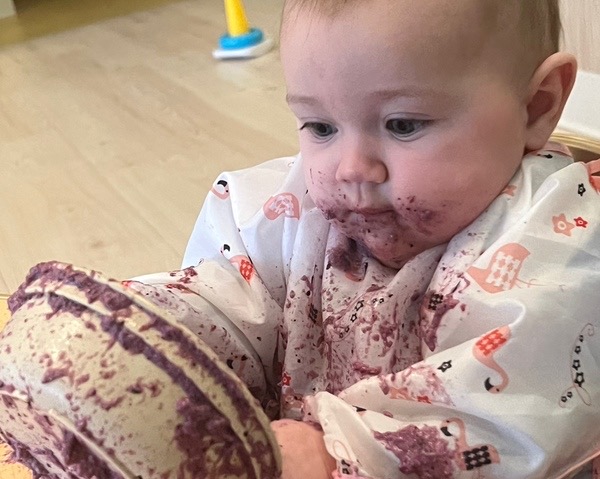
Now our granddaughter, The Guppy, is starting to eat solid foods. She’s trying new foods every day, and she’s adorable doing it. So far, so good. We hope her taste buds have unlimited horizons. The Guppy doesn’t have to join the Clean Plate Club. It will be enough if she can enjoy enough of a variety of foods that help her body feel good and stay healthy. That should be enough for me, too.

 Life through the Lens of Parkinson's
I always look forward to reading your blogs!
LikeLiked by 1 person